Your body gives you signals long before burnout, illness, or exhaustion show up. Heart Rate Variability (HRV) is one of the clearest, and most overlooked, indicators of how well your body is actually coping with stress. It’s a metric I’ve been paying much closer attention to.
HRV measures the small variations in time between each heartbeat. A healthy heart doesn’t beat at perfectly even intervals. Instead, it constantly adjusts based on sleep, movement, nutrition, emotions, and stress. Those adjustments are regulated by the nervous system, which is why HRV offers such valuable insight into overall health.
At a high level, HRV reflects the balance between two branches of the nervous system: the sympathetic system (fight or flight) and the parasympathetic system (rest and repair). When HRV is higher, the body can move more easily between these states. When it’s consistently low, it often means the body is carrying too much stress and not recovering fully.
This is what makes HRV so useful. Unlike metrics that focus on output such as steps, calories, and workouts, HRV reflects how well the body is coping. It often declines before someone feels burned out or run down, acting as an early signal that something needs to change.
Lower HRV levels are linked to chronic stress, inconsistent sleep, under-eating, excessive high-intensity exercise, alcohol, late meals, and constant stimulation (e.g. our phones).
The encouraging part is that HRV is highly responsive to positive changes. Consistent sleep and wake times, eating enough (especially carbohydrates), walking, morning sunlight, slower breathing with longer exhales, and intentional downtime all support nervous system regulation. Improving HRV isn’t about doing more, it’s about creating the conditions that allow the body to feel safe enough to recover.
A higher HRV doesn’t simply indicate better fitness. It reflects resilience which is the body’s ability to adapt to stress, recover efficiently, and maintain balance. That’s why HRV is increasingly used in performance, recovery, and longevity research. It gives insight into how the body is functioning beneath the surface, long before outward signs of strain appear.
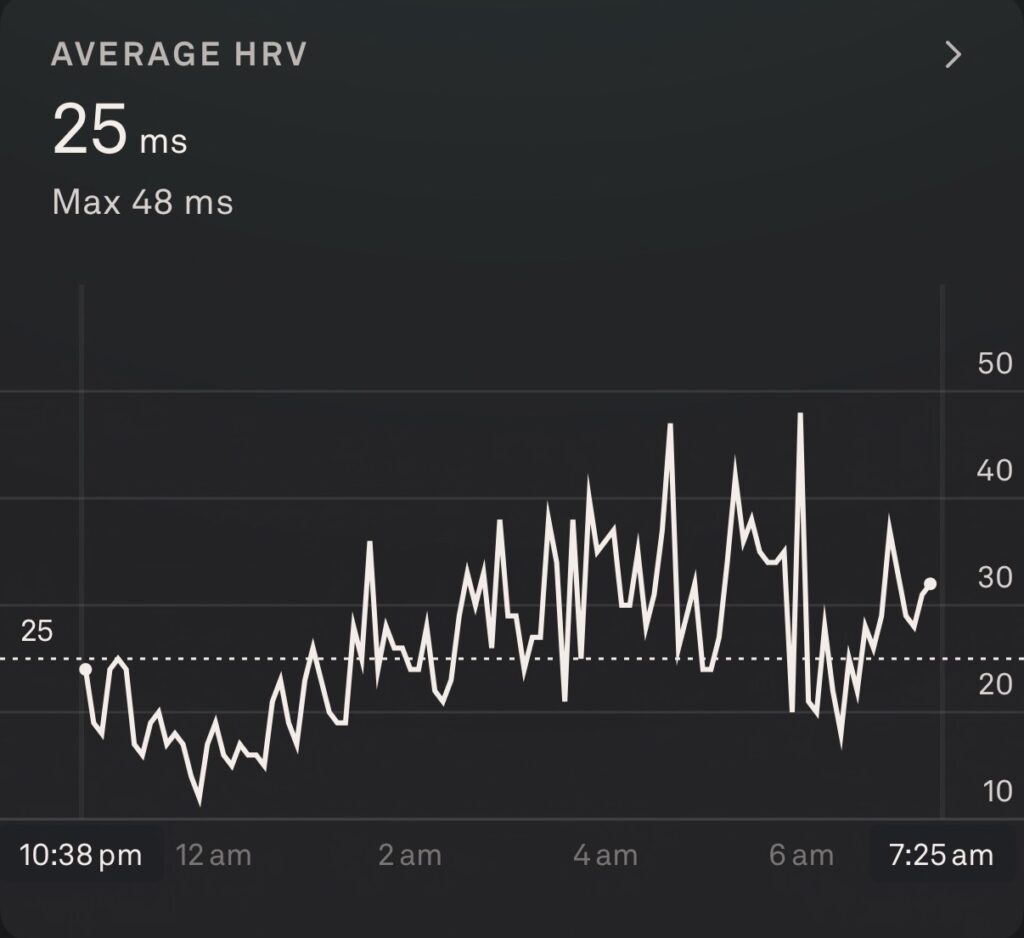
Personally, I’ve been working on improving my own HRV, which has been chronically low. I’m highly anxious by nature and learned early on how to be highly productive (a combination that can keep the nervous system stuck in overdrive). Last night, I spent about 20 minutes doing slow nasal breathing before bed (4-second inhale, 8-second exhale). I woke up to a noticeable improvement in my HRV (image is my reading from last night – my average HRV is usually around 22 with a max of 35).