
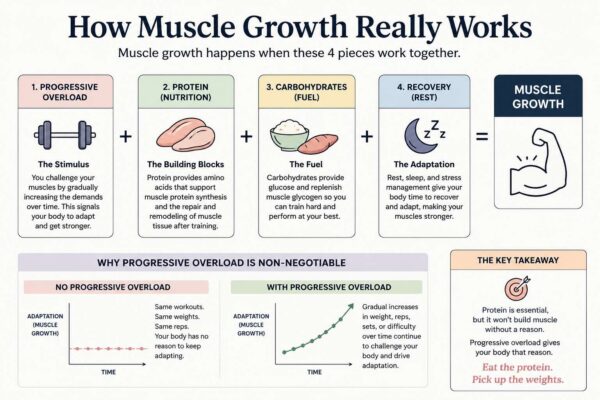
If you follow me, you know I am one of the biggest advocates for eating enough protein. I talk about it constantly. I prioritize it in my own meals, encourage women to pay attention to how much they’re getting, and believe it’s one of the most important nutrients for maintaining muscle, supporting recovery, staying satiated, and aging well. But there’s an important distinction I think we’re missing in the current protein craze: eating more protein alone doesn’t build muscle.You can eat 100, 120, or 150 grams of protein every day, but if you’re not giving your muscles a reason to grow, adding more protein isn’t going to magically create muscle. The actual stimulus for muscle growth comes from resistance training, specifically progressive overload. Protein supports the process. Strength training initiates it.
So, What Actually Builds Muscle?
Your body is incredibly adaptive. When you consistently challenge your muscles beyond what they’re currently accustomed to, you’re essentially sending your body a message that it needs to get stronger. Your body responds to that demand by adapting, and when that training is paired with adequate nutrition and recovery, those adaptations can include increased strength and muscle growth. This is where progressive overload comes in. Progressive overload simply means gradually increasing the demands placed on your muscles over time.
Let’s say you start doing goblet squats with a 20-pound dumbbell for three sets of eight reps. Eventually, those eight reps become easier. Maybe you increase to 10 reps, then 12, and eventually move up to a 25-pound dumbbell and start again at eight. That’s progressive overload. It can also mean improving your range of motion, adding another set, improving your technique, or increasing the difficulty of an exercise. You don’t have to lift heavier every single workout. The goal is simply to make sure your training continues to challenge you over time. If you’ve been using the same weights, doing the same reps, and performing the same workout for the last year, your body has very little reason to continue adapting.
Then Why Do I Talk About Protein So Much?
Because protein is still incredibly important. Strength training provides the stimulus for muscle growth, while protein provides the building blocks your body needs to respond to that stimulus. Dietary protein provides amino acids that support muscle protein synthesis and the repair and remodeling of muscle tissue after training.
Think about building a house. Strength training is the construction order telling the crew, We’re building something. Protein is the lumber, concrete, nails, and other materials needed to do the job. You need both. A garage full of building materials isn’t going to turn itself into a house. Similarly, eating a high-protein diet without challenging your muscles isn’t the same thing as actively building muscle. That’s the distinction I want more women to understand.
How Much Protein Do You Actually Need?
More isn’t always better. For active adults focused on building or maintaining muscle, somewhere around 1.4 to 2.0 grams of protein per kilogram of body weight per day, or roughly 0.6 to 0.9 grams per pound, is a commonly recommended range. For someone who weighs 150 pounds, that’s approximately 95 to 135 grams of protein per day. Instead of obsessing over one enormous protein-packed meal, I prefer focusing on getting a quality source of protein throughout the day. For many people, roughly 25 to 40 grams at meals can be a practical place to start, although individual needs vary.
And remember, your body needs more than protein. Carbohydrates help provide glucose and replenish muscle glycogen, which can help fuel the higher-intensity work you’re asking your muscles to perform. Healthy fats, micronutrients, hydration, sleep, and adequate overall calories matter too. You cannot expect your body to build well if you’re constantly under-fueling it.
Why This Matters Beyond Looking “Toned”
This conversation is about so much more than aesthetics. Muscle supports strength, bone health, metabolic health, glucose regulation, balance, physical function, and our ability to remain independent as we age. That’s why I want women thinking beyond simply becoming smaller. I don’t want your only measurement of progress to be the number on the scale. I want you to be strong. I want you carrying your groceries without thinking twice, lifting your suitcase into an overhead bin, getting up from the floor easily, traveling, hiking, playing with your kids or grandkids, and moving confidently through your life for decades to come. We need muscle for that.
Eat the Protein. Pick Up the Weights.
So yes, you’re going to continue hearing me talk about protein, and you should absolutely prioritize getting enough of it. But understand why you’re eating it. Resistance training tells your body it needs to become stronger. Progressive overload continues giving your muscles a reason to adapt. Protein provides the amino acids needed to support rebuilding. Carbohydrates help fuel the work, and recovery gives your body time to make those adaptations. They all work together.
Build balanced meals. Prioritize protein. Eat enough carbohydrates to fuel your training. Sleep. Recover. But if you want to build muscle, you have to challenge your muscles. Don’t just eat for the strong body you want. Train for it.